July 22, 2026 · Perry Hayer
Heavy Bag Workout for Beginners: 3 Rounds That Actually Work
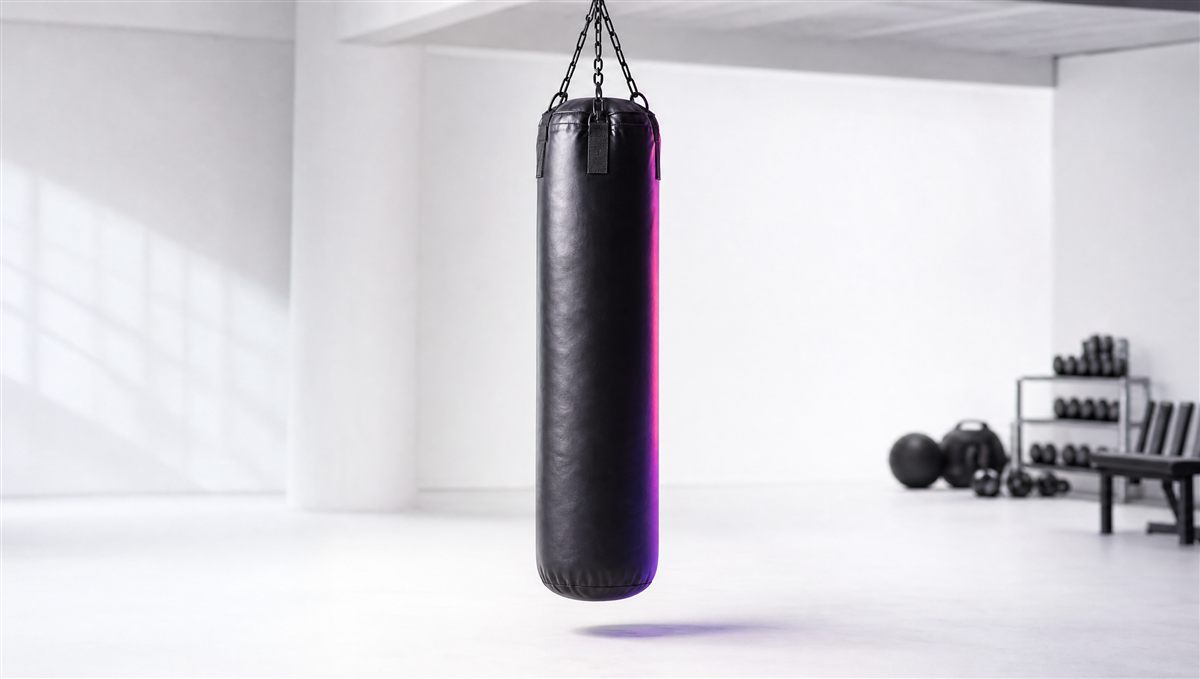
A beginner heavy bag workout needs exactly three things: three-minute rounds, two basic punches, and controlled power. That’s it. Three rounds of that is a real workout, and it will humble you in the best way.
Most people who train with me in Surrey have never hit anything in their lives. They’re not fighters. They’re teachers, tradespeople, parents, office workers who got bored of machines and curious about the bag hanging in the corner. If that’s you, good. This is your starting point.
Why is the heavy bag such a good workout?
Because nothing else trains strength and cardio in the same breath quite like it.
A punch isn’t an arm movement. It starts at the floor. Your feet drive, your hips rotate, your core transfers the force, and your fist just delivers the mail. Every honest punch is a full-body rep. String punches together for three minutes and your heart rate climbs like you’re doing sprint intervals — except you’re also producing and absorbing force the whole time.
That’s the hybrid most people are missing. Lifting builds strength but rarely leaves you gasping. Running builds your engine but does almost nothing for your upper body. The bag does both at once, and it keeps your brain switched on while it happens. You can zone out on a treadmill. You cannot zone out mid-combination.
What this means for you: one piece of equipment and twenty minutes covers strength, conditioning, and coordination in a single session.
How many calories does a heavy bag workout burn?
You’ll see wild numbers online. Ignore them.
A realistic figure for steady bag work is roughly 300 to 500 calories an hour, depending on your size, how hard you work, and how long you rest between rounds. A focused 20-minute beginner session lands somewhere around 100 to 170 — the same neighbourhood as a decent jog.
Here’s what the calorie charts miss: you’ll actually do this one. Nobody counts down the minutes on a heavy bag the way they do on a cardio machine. The rounds pull you in. And the workout you repeat three times a week beats the “better” workout you quit after two, every single time.
Why are rounds three minutes long?
Because that’s the shape of a fight, and it turns out to be the perfect shape for training too.
Three minutes is long enough that you have to pace yourself and short enough that you can push. The minute of rest between rounds teaches you to recover on a clock instead of scrolling your phone until you feel like moving again. Work, rest, repeat. It builds structure into your effort, and structure is what most beginners are missing.
If three minutes breaks you, start with two and build up. No shame in that. The clock doesn’t care about your ego, and neither do I.
The 3-round beginner heavy bag workout
Warm up first. Five minutes: arm circles, hip circles, light bouncing on the balls of your feet, and a round of easy air-punching. Wrap your hands and wear proper bag gloves. That part is non-negotiable — your wrists will thank you for decades.
Round 1 — jab and cross at 60 percent. Stand an arm’s length from the bag, one foot back, hands at your cheeks. Throw the jab — the straight punch off your lead hand. Then the cross — the straight punch off your back hand, with a small turn of the hip. Singles first, then jab-cross together. Cap your power at 60 percent. You’re learning to touch the bag with structure, not trying to break it. Hands come straight back to your face after every punch.
Rest one minute. Walk, don’t sit.
Round 2 — move between your punches. Same two punches, but now: throw, then step. Jab-cross, step left. Jab-cross, step right. Circle the bag in both directions. The bag will swing — let it, and time your next punches as it comes back to you. That swinging bag is your first moving opponent. Feet stay shoulder-width apart and never cross.
Rest one minute.
Round 3 — put your breathing in charge. Same punches, same movement. Now the focus is breath: a sharp exhale on every punch, steady breathing through the nose between combinations. When your form gets sloppy — and in round three it will — drop back to single jabs until it returns. Ending the round with clean, tired punches is the whole goal.
Twelve minutes of work. With the warm-up, call it twenty. Three sessions a week is plenty.
When those three rounds start feeling manageable — usually two to three weeks in — progress on purpose, one variable at a time. Week three, nudge the power to 70 percent on the cross only. Week four, add a fourth round. Week five, learn the lead hook and fold it in after the jab-cross. What you don’t do is change everything at once. The bag rewards patience the same way it punishes ego.
What do beginners get wrong on the heavy bag?
They swing for the fences on day one.
Power is the last thing you earn on a bag, not the first thing you bring to it. Wild, arm-only haymakers strain wrists and shoulders and build habits you’ll spend months unlearning. In my gym the rule is simple: speed and power are rewards for good form, never substitutes for it.
The other big ones: holding your breath (exhale on every punch), standing square and flat-footed in front of the bag (stay bladed, stay moving), and letting your hands drop to your waist between shots (they live at your cheeks). Fix those and you’re ahead of most people who ever lace up bag gloves.
What this means for you: go slower than you want to for the first month. The power arrives on its own, and it arrives properly.
Can hitting a bag really help with stress?
Yes — and not in a mystical way.
Bag work demands your full attention and your full body at the same time. You cannot replay a bad meeting mid-round. For twelve minutes your world shrinks to breath, feet, and the next punch, and most people find their head is quieter afterward than any amount of couch time makes it. I’ve trained more than 500 people, and that pattern repeats more than any other: walk in wound up, walk out level.
It’s not a cure for anything. It’s a pressure valve. But a reliable pressure valve, pulled three times a week, changes how the whole week feels.
Where do you go from here?
The bag is one pillar. If you want the full picture — the engine work, the strength work, how it all fits together for a regular person with a job — start with my beginner’s guide to fighter conditioning in Surrey, then see how the pieces stack in Train Like a Fighter.
I spent seven years in fight camps — 13 amateur MMA bouts between 2011 and 2018 — and everything I coach came through that filter. You don’t need to fight. You just need to train like it matters.
Start with my free 5-Day Kickstart: five short videos, five days, zero fluff. And when you’re ready for real coaching, book a session or email me at info@perryhayer.com. Bring your questions. The bag will handle the rest.
Ready to train like a fighter?
Start with the free 5-Day Kickstart, or book your first session with Perry in Surrey.